Perhaps no other game has more intricate rules than golf. The lawyers love this game; they can quibble about its many nuanced rules for hours.
No where else can you see championships changed by TV viewers calling in with rule challenges.
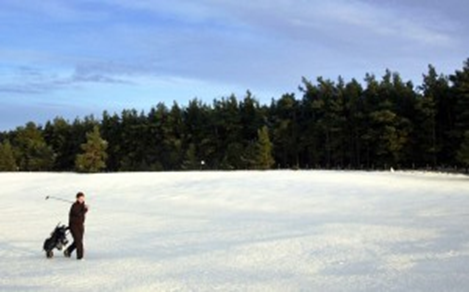
Too many rules makes for a duller game. So, we have some additional rules that take into consideration the climatic changes and particularly the unusual golfing climate of Canada.
Canadian Football has its own rules, as do the Australians. We need Canadian Rules Golf as well. Does Canada have the right? Remember that the first official Olympic gold medal for golf in 1904 was won by a Canadian. Canada was undefeated in Olympic golf for more than 100 years.
Golf can only be played outdoors for approximately two weeks out of every year in Canada due to climate. As a result, Canadian Rules Golf has evolved from the Ancient form of Golf as originally played way farther north in Scotland.
The differences take into consideration the distinctness of Canada, its climate and its environment. This is similar to the differences between American Football and Canadian Football, the two games come from the same root but offer variations for the sophisticated player.
These rules were developed to take some of the severe seasonal differences out of the game making it easier to compare performance through the course of the playing season.
These rules only apply to Canadians or Canadian residents. Note: these rules may be applied, by those who qualify, to play on golf courses outside of Canada. Use of Canadian rules must be declared before beginning a match.
- Winter conditions are judged to be always in effect, particularly in relation to improving the ball’s lie.
- Since all water hazards are presumed to be frozen, a ball striking water will be presumed to have bounced across. The ball should then be placed where it is judged to have normally landed after bouncing on the ice.
- Since Canada is remote as possible from the Sahara, sand will be considered an unnatural obstacle. The ball should therefore be placed away from the sand at a point equidistant from the hole.
- Canada uses the metric system. Therefore, no more than ten strokes can be counted on any one hole. Hockey stick (7), snowmen (8) and lacrosse sticks (9) are allowed.
- A player may use only one wood club per stroke. Therefore, if the ball, once struck, hits another wood object then that second, or third, or fourth hit will be disallowed. The ball should then be placed where its natural flight path, from the first stroke, would have carried it. With Canada’s commitment to forestry, uncut down trees should be honoured and respected.
- Because of Canada’s continuing commitment to the environment, the ball must be removed from proximity to any vegetation which could be harmed accidentally by the player. This includes overhanging branches and nearby tree and/or bushes. Remember, it is only a game to you; but it could be a life threat to the plant.
- When warning players ahead, players must simultaneously shout “Fore” and “Quatre” due to Canada’s bilingual culture. Any player who gives undue emphasis to one language or the other may be penalized by up to un stroke.
- When encountering rough grass, hockey sticks are permitted as acceptable clubs.
- Despite Canada’s enthusiasm for curling, there is no sweeping allowed on putts in motion to improve distance or straighten their direction.
- Given the winter conditions, warm-up is extremely difficult. Therefore, the first tee may substitute for the warm-up. As many strokes as required to achieve a satisfactory result may be taken from the first tee.
- A ball that can not easily be found will be considered to have been “lost in the snow” for which there is no penalty. The player must loudly make this declaration. A replacement ball can then be placed on the fairway where the first is judged to have landed. Note: to standardize playing conditions, this rule will be in effect all year, regardless of the presence of snow.
- Recognizing Canada’s proximity to the North Pole where gravity is stronger, a ball which passes over the cup will be deemed to have fallen in.
One curiosity of Canadian golf is the proliferation of left-handed golfers. It is widely known that Canada has the highest percentage of left-handed golfers. It is credited to kids playing hockey before they play golf.
Mike Weir, a right-handed Canadian who plays golf left-handed, has won the Masters. Notwithstanding the relationship with hockey, cross checking is no longer allowed in Canadian Rules Golf.