It was in the 1970s I was hired to work with a client, Heublein, that had been in the liquor business for some time. They had recently purchased a couple of food companies and had hired a President and marketing managers, mostly from General Foods, to work on the products.
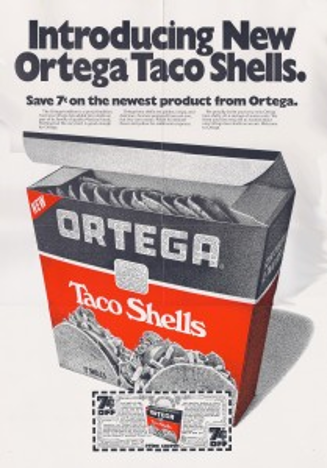
I had worked a lot with General Foods so it seemed like a good fit. Our task was to increase the sales of their Mexican foods. The company had two existing lines: Ortega chiles and Snap-E-Tom tomato juice with chiles in the juice.
Already in the market nationally was a line called Old El Paso, which was generally located in a small section of ethnic or international foods in most grocery stores. Old El Paso had many Mexican food products from taco seasoning to jalapeños to nopalitos (pickled cactus) to refried beans. It was not mainstream.
Regionally, in the southwestern part of the US which used to be part of Mexico, there were many regional Mexican food products, usually each brand specialized – Rosarita produced refried beans, Ortega had chiles, there were many hot sauces. Once you were out of the southwest, Mexican foods were treated as exotic and were generally unknown.
Taco Bell fast food stores, in that era, were limited to California and the southwestern US. This was decades before the Food Channel. US citizens were even more xenophobic in that era than they are today.
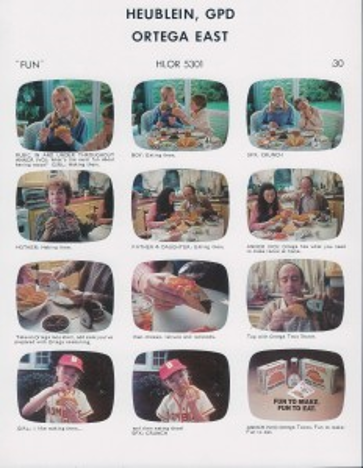
Our strategy in launching Ortega was to focus on a simple-to-make taco kit and present it to be as mainstream as possible. Our model was based on pizza, a food which was no longer considered Italian ethnic food but something everyone was familiar with and liked. Mainstream is a deeper pool to fish in.

The advertising we developed focused on families having fun making and eating their own taco. The phrases “I like making them” and “I like eating them” were repeated by a series of mainstream looking people of all ages. We made tacos sound like hamburgers.
The day after recall (DAR) of the commercial set records in the Burke DAR test with a score of 54. I had been used to commercials that scored around 20, so this one hit it out of the ballpark. Hats off to Charlie Glass and Ed McCabe the creative team.
Ortega was a brand known for producing the best canned green chiles, Anaheims from the Oxnard area northwest of L.A. A focus of our print advertising for the sauces, seasoning mix and canned products played on “the best chiles make the best sauce”. Our approach was always, “tacos are an everyday food” and we made little or no reference to their being Mexican.
For the huge chunk of the US that was formerly part of Mexico, tacos were already just everyday food. For the rest of the US, tacos rapidly did become an everyday food, pretty much like pizza.
It taught me that integrating a new idea is easier if people think it is nothing unusual, a small interesting step, just an extension of what they were already doing.
I have used the same strategy with fast food clients – when Subway introduced a chipotle chicken sub, when Extreme Pita did Asian flavoured chicken in their pitas and when we helped launch Mucho Burrito. Standing in line at Subway at the launch of the chipotle chicken sandwich, I heard folks in the line talking about whether they would try the “chip-o-tile” version… was it too spicy. Clearly something new with a funny name which quickly became nothing new at all.
People are generally hesitant to be too daring with their food choices, but if they are assured it is a small step worth taking, they will take it. So often the unfamiliar can be broken down into familiar elements so folks can take safe baby steps to their destination..
If you liked this, read more at Calexis.com