In math, asymptotes are curves that flatten out and never reach an upper limit. Most of us know the puzzle of the frog that can jump halfway to its goal. If it keeps jumping halfway, it will never get there. That is an asymptote. A point of diminishing return.
Brands are constantly looking to improve themselves, jumping towards their goal. There are many reasons for this: to be more profitable, to pre-empt competitive incursions, to make themselves perform better and be more interesting for their users.
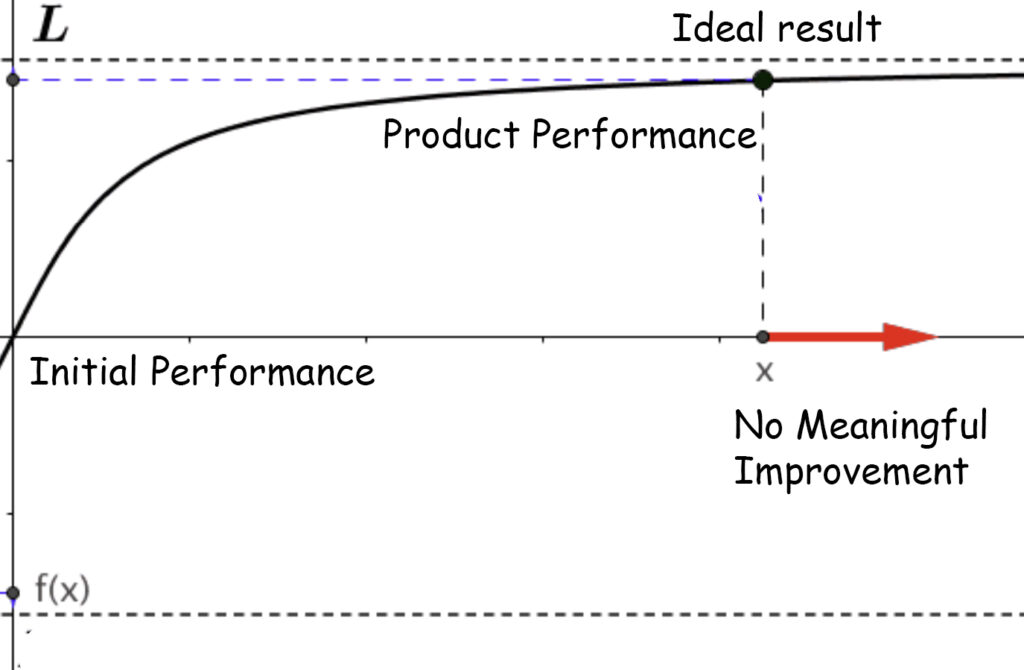
Over the years, I have participated in many of these projects. The idea of improvement was highly linked to expecting increased sales. The axiom was that the most powerful advertising words were “New” and “Improved.”
The question is, how much can a product performance improve? Are such improvements meaningful? Are there diminishing returns with each improvement? Are improvements asymptotic to acceptable performance? And, does the user base become immune to brands continuous claims?
How much better is Tide today at cleaning my clothes, versus Tide ten years ago? Even after many improvements.. Do I notice the cleaning difference even if there is one? More importantly, am I willing to pay extra or be more brand loyal because of any “improvement”? Marketing has done too good a job convincing consumers of the degree of improvement in products. Advertising magnifies the small differences by hyperbolically pointing them out.
Retailers have grown their private label businesses based on consumers’ diminishing ability to notice improvements and the over use of the claims. This erodes the “added value” created by branding but the psychology that makes people more confident because of the brand name remains.
Drugs are an interesting case. They get protection when they are patented for 20 years. In reality it is less time because of the time taken to get government approval to sell after the patent. Once that is over, generic versions of the same compound are readily available at a fraction of the cost. Many people want to stick to the brand name based on advertising and the confidence associated with the brand. That trust may be eroding and the trust equates to value.
When PCs were introduced, a two year old computer was considered really old and slow – an tintique. Each new generation was hailed as revolutionary. The improvements were noticeable. Following Moore’s Law, there were improvements. Today, the difference between last year’s computer and today’s is slightly below marginal. Part of that is not fair as software has become more demanding of computer performance. That means to the user, the difference is not that noticeable.
Cell phones do not connect better, but they take slightly better photos. Is that improvement meaningful and motivating enough to have customers pay $1500 for the iPhone23 or 24?

The way to add value through product changes may be to add peripheral features. Fax machines did that, adding many features that users never understood or used. Then came a radical change, the pdf, that change made fax machines virtually obsolete.
The same is happening with cell phones now as they have become a tech Swiss arm knife for your pocket: instant messages or emails to everyone you know, taking photos, being a wallet, connection to the internet and all accumulated knowledge, language translator, document storage, health monitoring… I’m tired of listing. The device has metamorphized from being a phone into something else, even if we still call it a phone.
The sales leverage of “new, improved” or latest model has been disappearing. It is not the easy answer or silver bullet, to adding marketing oomph that maybe it once was.
If you liked this, read more at Calexis.com