General Foods maintained a large testing kennel in Kankakee, Illinois. It was close to their dog food manufacturing plant. During the 70s when I worked on their dog food advertising, they had a very successful dog food business.
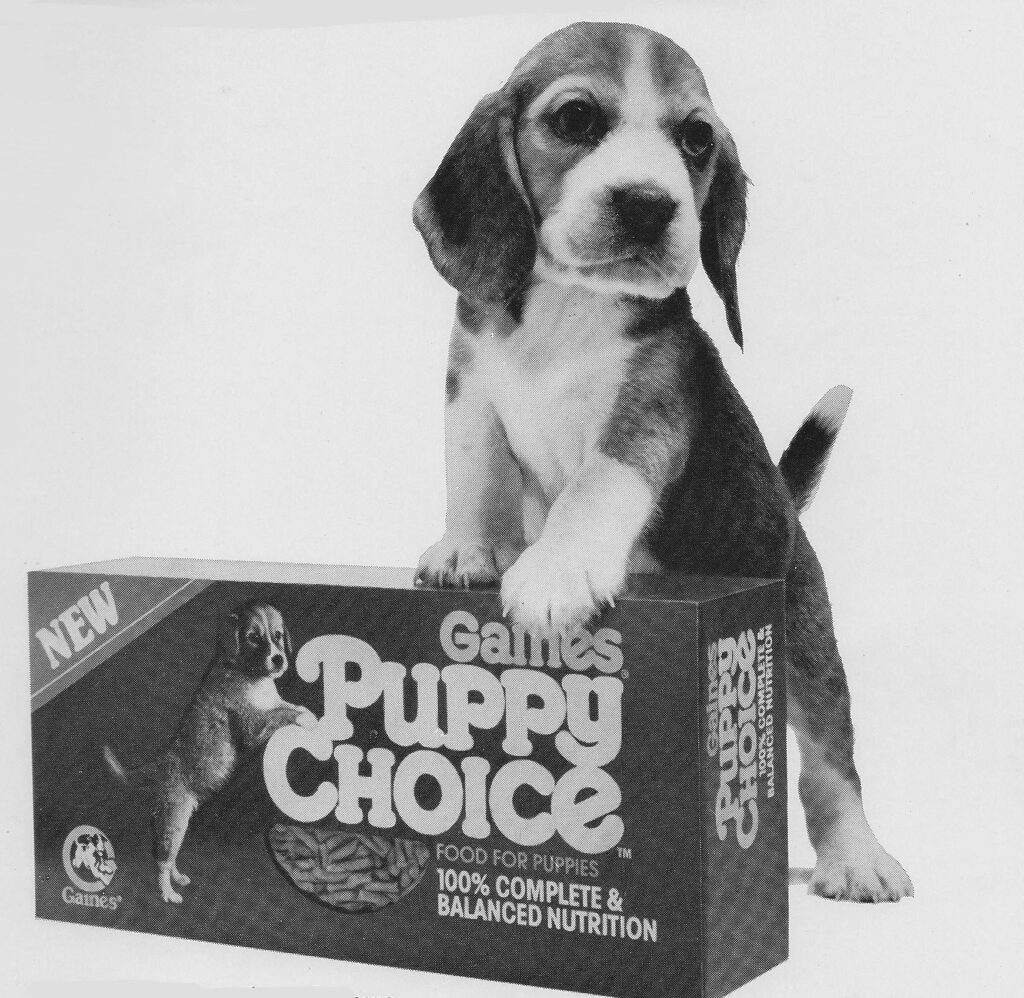
GF sold dry food: Gaines Meal and Gravy Train both dry; semi-moist foods: Gaines-Burgers (in several flavours), and Top Choice chunks (in regular and Puppy Choice versions); and the Cycle brand of four types of foods in dry or canned forms designed for each stage of a dog’s life from puppy, to adult, to overweight, to older dogs.
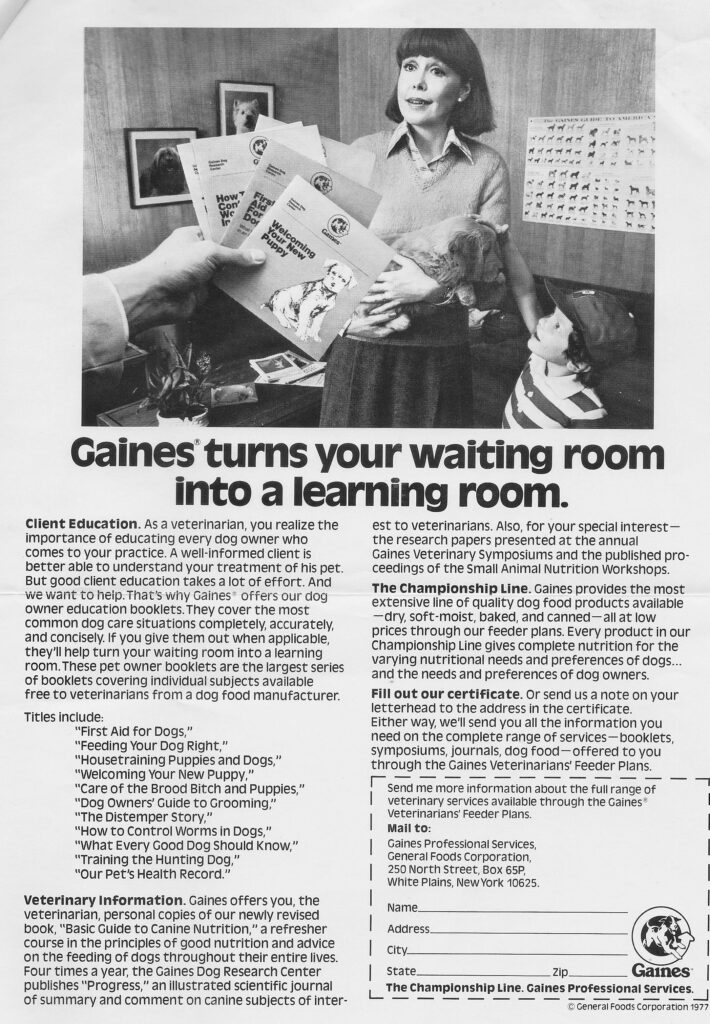
Gaines also operated a Gaines Professional Services business that delivered large orders of product, typically pallet loads, to veterinarians, breeders, and professional kennels for their use and resale. The advertising to veterinarians gave me my first advertising modeling experience. Look at that handsome hand with the brochures!
These businesses’ sales would be equivalent to more than a billion dollars in sales in today’s dollars. I was working primarily with Gravy Train and the professional services businesses so had to learn about all of these products to know about the advertising claims.
It was a very interesting business. We did psychological profiling of dog owners to better understand their purchase behaviour. There were different psychological groups: some saw their dog as a surrogate child, some saw the dog as livestock, some as a family member and companion, some as a working member of the family (like a watchdog or herder). This was before there were very many guide dogs or support animals.
Depending on the owner’s perception of the dog, the feeding protocol was different. The dog as a surrogate child, for example, tended to be a smaller breed and was fed more expensive canned food or even freshly prepared food. Livestock dogs were just fed dry meal which was the cheapest option. Gravy Train which made gravy when you added water, allowed families to feel they were preparing a meal for their pet/family member. And so forth. Psychographics are a good way to understand your buyers thinking and feeling, beyond just their demographics.
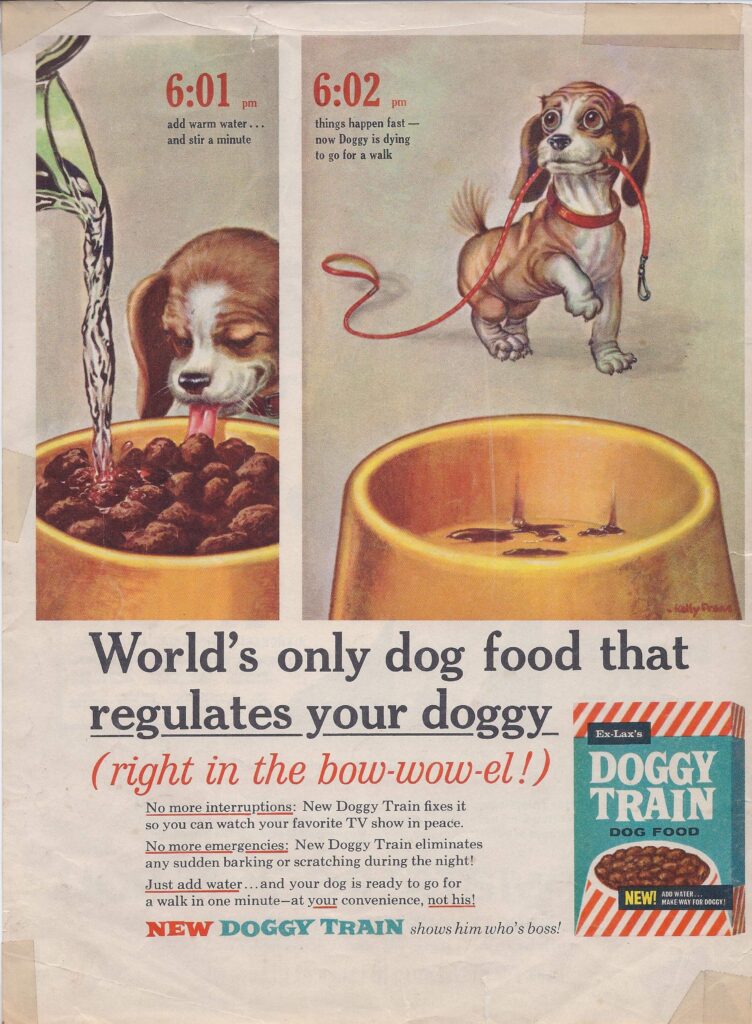
To address what the perfect dog food would be, we held a product development meeting in Kankakee where we sat for a few hours with the marketing team, veterinarians, manufacturing, scientists, and kennel support personnel discussing how we would be able to design the perfect dog food.
The conclusion from our meeting was that owners determined whether the dog food was any good by seeing if the dog ate it and by examining their dog’s stools. If the stools looked right, they would be happy with the dog food. So, Bob, our PhD in Veterinary Sciences, was assigned to write a paper on what he considered to be “the perfect stool.” I had a few personal candidates I could have nominated. Maybe you do too.
While we do anthropomorphize dogs attitudes about many things, they are not very fussy eaters. We never had problems with dogs eating during shoots. We just put garlic paste on the bottom on their bowl and they dug right in. Garlic paste smells like rotting meat to the dog. Nevertheless dogs can be trained to be picky eaters by their owners.
In advertising a dog food, if you want to make a claim of “beefy tasting,” you cannot just ask a dog like you can a person, You needed to have trained a dog that only ate food that you could prove was “beefy tasting.” If it did not taste like beef, the trained dog would reject it and not eat it. That confirmed that it was beefy tasting to dogs and allowed us make the claim.
That brings us to a conundrum that came up. Research showed that many people fed their dogs table scraps. Table scraps may, in fact, be how humans and dogs created their very special relationship in the beginning. A new product idea was to create a dog food that was better nutritionally than table scraps but that looked like beef stew.
Beef stew is a lot like Gravy Train but it also would have to include chunks that looked like potatoes, carrots and peas. These would be simulated by using extruded grain based kibble sprayed with different flavoured slurries. But to make the claim, there was a need to say these chunks tasted like potatoes, carrots and peas.
Just looking like something wasn’t good enough; if we claimed it tasted like stew we had to prove it. That meant a generation of tasting dogs had to be trained to prove, for advertising, that the kibble tasted like potatoes, like carrots and like peas. And so it was done in the kennels of Kankakee.
Unfortunately, the beef stew product did not test well enough to get out of test market, despite having the trained canine taste panel to support the claims.
A few years later, only the pea dog was left of the initiative. There was no attempt to change its diet considering the possibility that the product, or another like it, might be revived at some point. It was easier to keep feeding the dog peas. The pea dog lived out its life in the Kankakee kennels on a diet of peas, which I might add have excellent protein value.
You might say the pea dog dedicated its life to a lost cause. If so, it wouldn’t have been the first.
(Thanks to my old friend Tony, who reminded me of the pea dog story 40 years later when he was about to read Overcome AD-versity)
If you liked this, read more at Calexis.com