It took some explanation for me to understand that washing clothes was not something done in a basement room, but the opposite, on a rooftop. It was part of my learning when I started working in the 1980s in Venezuela on heavy-duty detergent, Ariel, made by Procter & Gamble. You have to put your preconceived notions aside and understand reality as it is in the environment you are in.
At the time in Caracas, many families lived in apartment buildings. Few women worked outside the home. Clothes were washed by the women of the home on apartment building rooftops, called azotea, where large flat areas included water access, cement sinks, scrubbing areas, and clothes lines for drying. The roof top was a practical area because the weather; most of the year was warm and sunny. That made drying clothes easy. The rooftop became like the centre of a small town for residents.
The typical laundry process was for women to soak dirty clothes in buckets, aided by some detergent in the water. This pre-wash soaking was called “the removal” by the housewives.
The women had a lot of hard work to do scrubbing away on dirty clothes, but they also enjoyed the socializing as a group gathering on the rooftop to all do similar work. I visited a couple rooftops to understand the physical and social environment where the product was being used. There was a lot of chatter going on along with the activity.
Detergents are chemical products that use surfactants to separate dirt from fabrics by lowering the surface tension between them. Soaps dissolve the dirt to remove it but they can be weakened by minerals in the water. Ariel was a detergent that also had an active biological enzyme that broke down food stains to improve its cleaning power. The brand had a slight sales lead over two main laundry powder competitors: ACE (also from P&G) and ABC (Colgate).
When you work on a product’s advertising, you need to understand the product or service’s function and the context in which it is used. Talking to users, especially when the product is in use, is invaluable. They tell you about their experiences using their language to describe their activity that you can then use to speak more convincingly to others.
Our advertising emphasized the biological and detergent power using a visual mnemonic device. In commercials, when a woman put her dirty clothes in a bucket to soak, the bucket started to rotate back and forth as if it were a washing machine. She steps back with an expression of amazement.
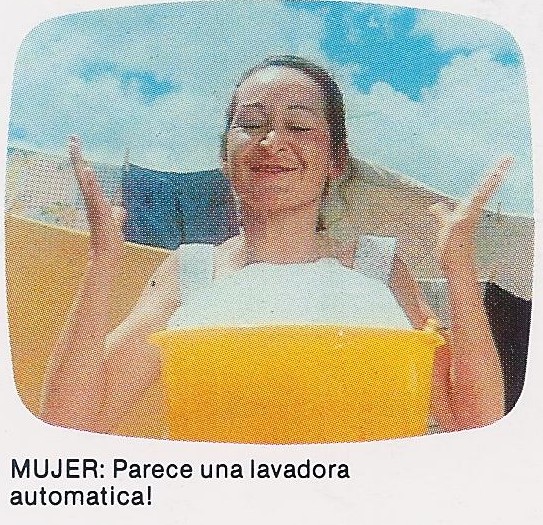
Our special effects were not high-tech CGI, not too Hollywood. The bucket sat on a turntable and a production crew member out of the camera frame held ropes that he pulled back and forth to make the bucket move. Just ropes and a turntable. See the crew member in blue on the left
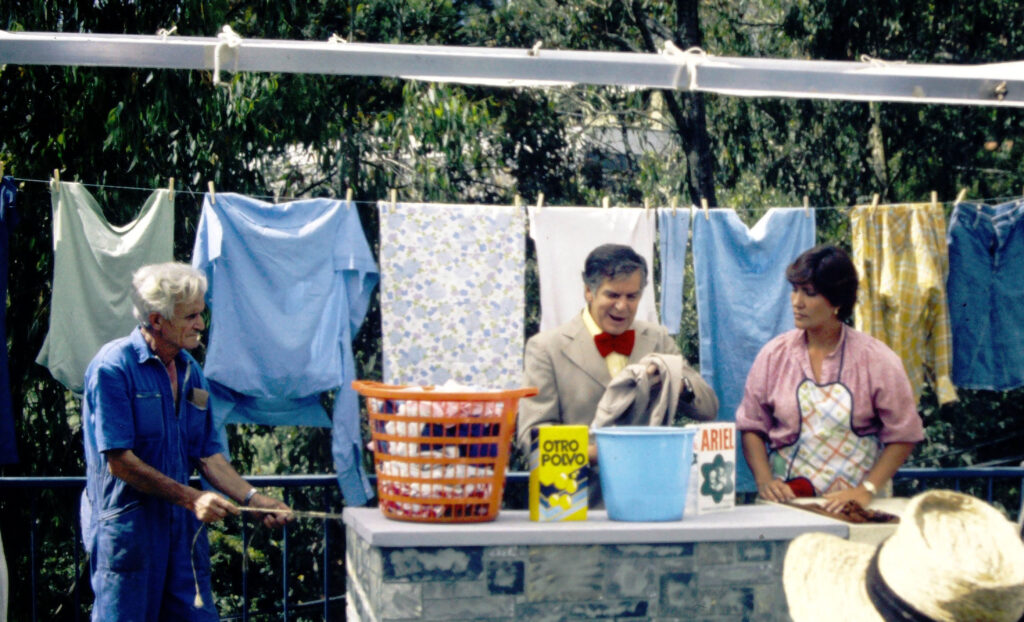
The commercials were all took place on a roof top with a group of women, most of whom were having a good time doing some activity – playing games, getting their fortunes told, trying diet cures, taking courses, and so on. One women, using another detergent, was scrubbing away alone and feeling sorry for herself because she was the only
Our spokesman was Henry Altuve, the host on a popular multi-hour Saturday evening TV variety show. Henry was a much-beloved host. Henry and I would have lunch about once a year for me to get feedback from him. He was always enthusiast and fun to be around.
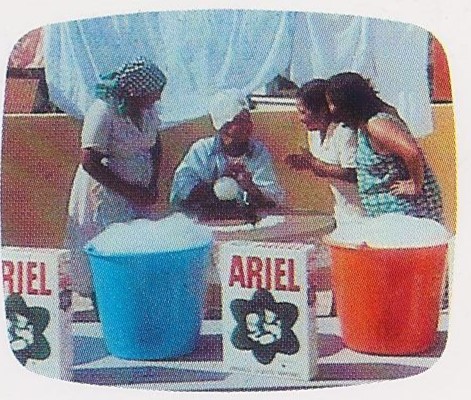
Henry is the ringleader for the women having fun and intervenes to explain to the woman using the competitive product that the others are relaxing while the power of Ariel cleans their dirty clothes with its double action.
These commercials were shot on Caracas apartment rooftops and took a whole day to shoot. It was really hot, with the sun beating down on us. Nevertheless, everyone seemed to have a good time. When they weren’t needed, the actors huddled under a sun cover shelter our production team had put up. We tried to do the same and drink a lot of liquids.
Our advertising for Ariel had a coming challenge. With the mnemonic device simulating a washing machine, what would we be able to do once washing machines came aggressively into the market? one working. Very few homes had washing machines, but it was just a matter of time.
We had an answer. The non-user has a washing machine, but it doesn’t clean effectively with the wrong detergent. When Henry arrives with Ariel, the Ariel makes the washing machines start chugging away as soon as it is added. The doubting washer exclaims “it does ‘chaca-chaca’ on its own!” Henry explains that Ariel works even better in a washing machine.
We shot about half a dozen commercials each year. Once we had a washing machine (chaca-chaca) version, we rotated versions evenly between the buckets and the washing machines.
That transition helped Ariel rise to dominance in the heavy-duty detergent category. We were assisted by our radio campaign which we have covered in other blog stories.
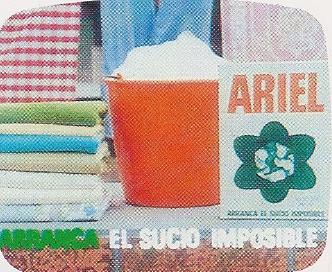
The catch phrase “chaca-chaca” quickly became associated with Henry and he used it on his weekly TV show. It was also picked up and also used in popular culture to signify having sex. Doing the chaca-chaca. This was okay with us. The more people who used the phrase, the greater the awareness for Ariel.
Recently, now 40 years later, I read an on-line blog from Venezuela that referenced the “chaca-chaca” action from the old Ariel commercials, adding an ingredient to bring something to life, as a metaphor for AI. Who knew that the catch line in a commercial would last that long.
If you liked this, read more at Calexis.com